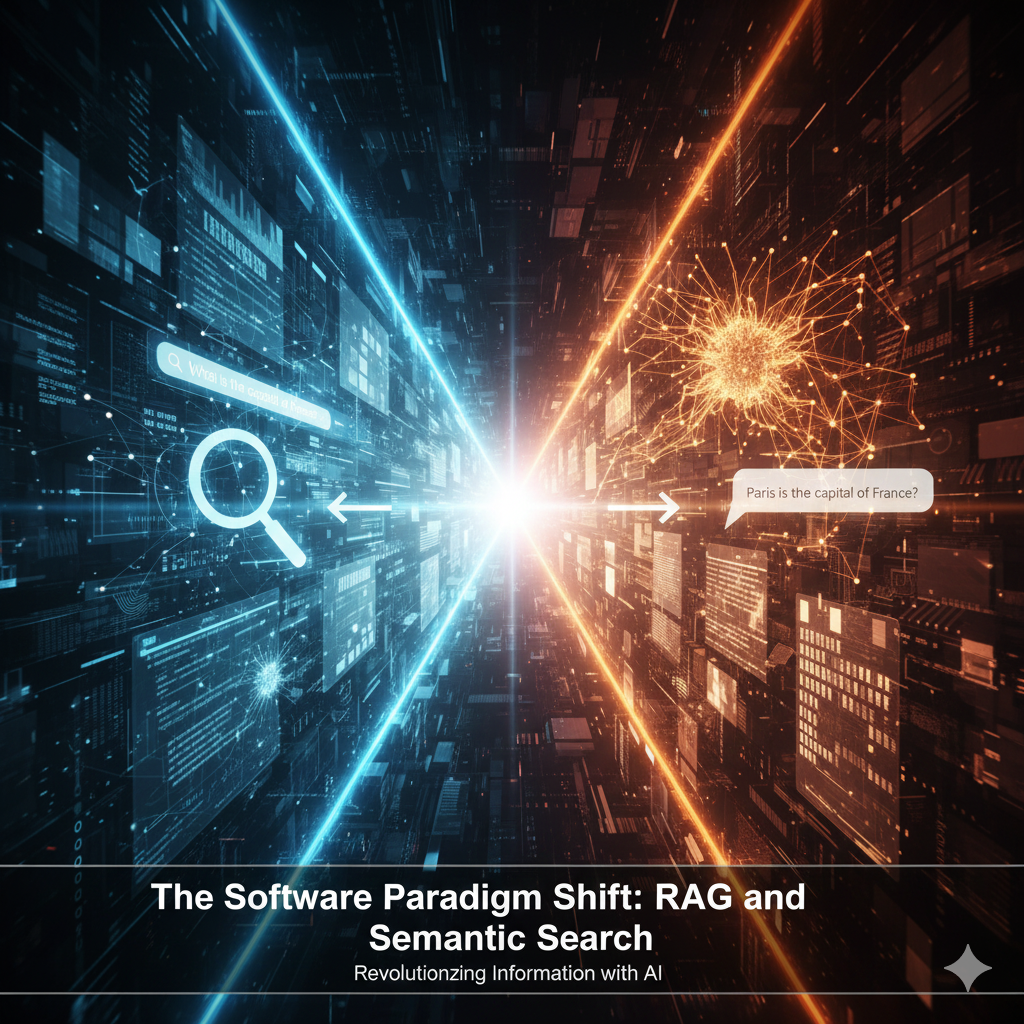
In the ever-evolving landscape of technology, the field of Natural Language Processing (NLP) is witnessing a significant paradigm shift powered by advancements in Retrieval-Augmented Generation (RAG) and semantic search. These innovations are redefining the capabilities of software systems, enabling more accurate, efficient, and context-aware information processing. This article explores the transformative impact of RAG and the evolution of semantic search, along with their integration with machine learning and the role of knowledge graphs in enhancing search capabilities. We also delve into the challenges and opportunities posed by big data, emphasizing the need for continued innovation.
Retrieval-Augmented Generation (RAG) as a Transformative Approach
Retrieval-Augmented Generation (RAG) is emerging as a groundbreaking approach in the domain of knowledge-intensive NLP tasks, such as open-domain question answering. By uniquely combining retrieval and generation components, RAG systems can access external knowledge sources, leading to enhanced accuracy and efficiency. This capability represents a significant shift in the design and implementation of NLP systems.
RAG leverages the strength of both retrieving relevant information and generating coherent responses, making it an ideal solution for tasks that require deep integration of various data points and contextual understanding. RAG’s ability to access external databases allows it to perform remarkably well even in complex scenarios, potentially transforming traditional NLP models into more robust and intelligent systems.
The Evolution and Impact of Semantic Search
Semantic search is undergoing a revolutionary transformation from traditional keyword-based systems to more sophisticated models that utilize deep learning, knowledge graphs, and machine learning. This evolution is crucial for enhancing search relevance and improving user experience, especially in the context of managing and navigating big data.
The modern semantic search systems aim to understand the user’s intent and the context behind search queries, leading to more meaningful and relevant results. This trend is moving towards context-aware search capabilities that significantly enhance user satisfaction and engagement. Semantic search’s evolution is pivotal in creating a seamless and intuitive user experience by delivering results that align more closely with user expectations.
Integration of Semantic Search with Machine Learning
The integration of semantic search techniques with machine learning models is proving to be a powerful strategy in enhancing information retrieval systems. This combination exploits the strengths of semantic understanding and predictive algorithms, leading to improved search accuracy and relevance.
By applying machine learning techniques, semantic search systems can learn and adapt to user behavior, providing more personalized and precise results. The implications of this integration are profound, as it addresses the limitations of traditional search systems and paves the way for more intelligent and adaptive search solutions. Researchers explore this integration further, demonstrating how machine learning enhances semantic search capabilities.
Role of Knowledge Graphs in Enhancing Search Capabilities
Knowledge graphs play a crucial role in enhancing semantic search capabilities by providing structured representations of information. They enable search systems to deliver more accurate and context-aware results, improving overall search relevance and user satisfaction.
Knowledge graphs offer a framework for linking related concepts and entities, allowing search systems to understand the relationships between different data points. This structured approach to data representation enhances the ability of search engines to interpret user queries accurately and provide comprehensive answers. Researchers discuss the pivotal role of knowledge graphs in this process, highlighting both the challenges and opportunities they present for future research.
Semantic Search in the Context of Big Data
Implementing semantic search in big data environments presents both challenges and opportunities. Traditional search methods often struggle with large-scale datasets, but semantic search offers a viable solution to improve relevance and efficiency.
The volume and complexity of data are growing exponentially, necessitating scalable and robust semantic search solutions. These systems are essential for handling the increasing data deluge, providing users with relevant information quickly and efficiently. Researchers emphasize the importance of semantic search in big data, calling for continued innovation to keep pace with the demands of modern data environments.
Conclusion
The ongoing advancements in Retrieval-Augmented Generation and semantic search are poised to redefine the landscape of NLP and information retrieval. By integrating external knowledge sources and leveraging machine learning, these technologies offer new possibilities for creating more intelligent, accurate, and context-aware systems. The use of knowledge graphs further strengthens the capabilities of semantic search, while the challenges posed by big data drive the need for ongoing innovation.
As we navigate this software paradigm shift, it is crucial for researchers and practitioners to continue exploring these technologies’ vast potential, ensuring that the systems we build are not only technologically advanced but also user-centric and efficient.

Abhijit Daund (AD)
AD is a Senior Engineering Manager and the founder of ads2cents.com. With 13+ years of experience at companies like Walmart, he specializes in distributed systems, AI infrastructure, and software systems.