In today’s rapidly evolving digital landscape, businesses are increasingly turning to artificial intelligence (AI) to gain a competitive edge. AI agents, with their ability to process data and make decisions autonomously, are transforming how companies operate, innovate, and grow. This blog post explores how businesses can effectively build and integrate a team of AI agents into their operations, focusing on strategic insights such as integration and collaboration, ethical considerations, scalability, innovation, and human-AI collaboration.
Integration and Collaboration of AI Agents
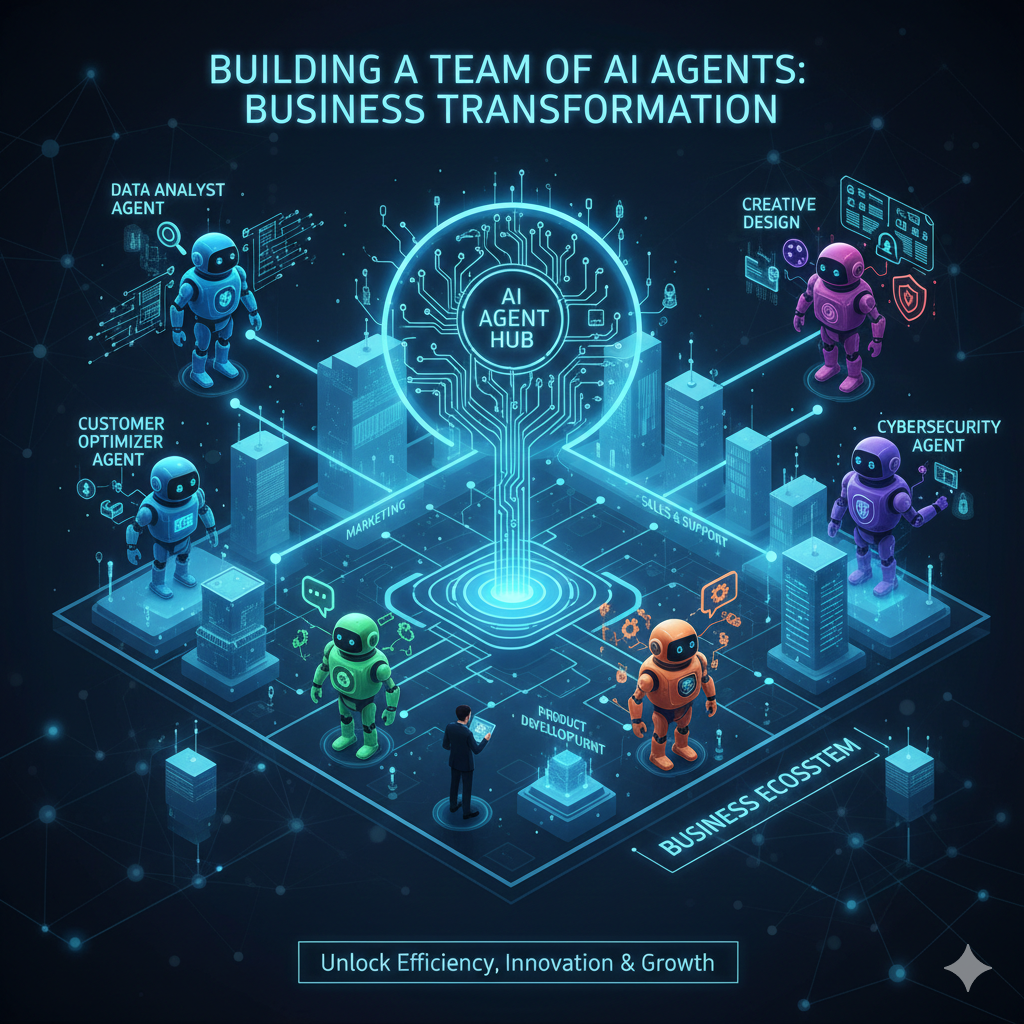
The integration of AI agents into business operations is not merely a technological upgrade but a strategic transformation. Effective integration requires a seamless collaboration between AI agents and human workers. Multi-agent systems need to be designed to facilitate communication, coordination, and conflict resolution, thereby enhancing business performance and driving innovation.
When designing multi-agent systems, businesses must focus on interoperability and coherence. AI agents should be capable of sharing data and insights transparently, ensuring that human colleagues can understand and act upon the AI’s recommendations. This involves creating protocols that allow for efficient data exchange and decision-making processes that are clear and accountable.
Seamless collaboration between AI agents and human workers can lead to significant improvements in business performance. AI agents can handle repetitive, data-driven tasks, freeing up human employees to focus on strategic, creative, and complex problem-solving activities. This not only boosts productivity but also enhances job satisfaction and employee engagement.
Ethical and Regulatory Considerations
Deploying AI agents comes with a set of ethical and regulatory challenges that businesses must address to ensure responsible AI deployment. Transparency, accountability, and bias are key concerns that need to be managed through well-defined ethical guidelines and regulatory frameworks.
Businesses must ensure that their AI systems operate transparently, with clear documentation and explainability of AI decisions. This builds trust among stakeholders and mitigates risks associated with AI decision-making. Accountability structures must be in place to address any potential errors or biases in AI systems.
To secure long-term success, businesses should engage stakeholders in developing ethical AI guidelines. This involves identifying potential biases in AI systems and implementing corrective measures to ensure fairness and equity. Compliance with regulatory standards also ensures that AI deployments are aligned with legal and societal expectations.
Scalability and Resilience in AI Systems
For businesses to fully leverage the power of AI, they need to focus on scalability and resilience. Scalable AI architectures are essential for handling large-scale operations and adapting to changing business environments.
Creating scalable AI systems involves addressing technical challenges such as data management and network infrastructure. Systems should be designed to handle increased loads without compromising performance or reliability. This often requires investments in robust IT infrastructure and cloud-based solutions that can support AI operations at scale.
Resilience in AI systems is crucial for maintaining business continuity in the face of disruptions. This involves building AI systems that can adapt to unforeseen changes and recover from failures quickly. Regular testing and simulations can help identify potential vulnerabilities and improve system robustness.
AI as a Driver of Business Innovation and Efficiency
AI agents are powerful drivers of business innovation and efficiency. By automating routine tasks and enhancing decision-making capabilities, AI can reduce costs, enhance scalability, and foster innovation.
AI agents excel at automating repetitive and time-consuming tasks, allowing businesses to streamline operations and reduce human error. This automation frees up resources, enabling companies to allocate their workforce to more strategic initiatives.
AI agents can process vast amounts of data to provide insights that inform strategic decisions. This capability empowers businesses to make data-driven decisions that enhance efficiency and competitiveness. Continuous monitoring and optimization of AI systems are essential to maximize these benefits.
Human-AI Collaboration and Workforce Dynamics
The integration of AI agents into business operations reshapes workforce dynamics and emphasizes the importance of human-AI collaboration.
AI agents and human workers bring complementary strengths to the table. While AI excels at data processing and pattern recognition, humans are better at creative thinking and contextual understanding. By leveraging these complementary strengths, businesses can enhance productivity and drive innovation.
Implementing AI systems requires effective change management strategies to support human workers in adapting to new technologies. Training programs and ongoing support are crucial for ensuring that employees can work effectively alongside AI agents, fostering a collaborative organizational culture.
Conclusion
Building a team of AI agents to transform your business involves more than just deploying cutting-edge technology. It requires strategic planning, ethical considerations, scalable architectures, and a focus on human-AI collaboration. By addressing these key areas, businesses can harness the full potential of AI to drive innovation, improve efficiency, and achieve sustainable growth.

Abhijit Daund (AD)
AD is a Senior Engineering Manager and the founder of ads2cents.com. With 13+ years of experience at companies like Walmart, he specializes in distributed systems, AI infrastructure, and software systems.