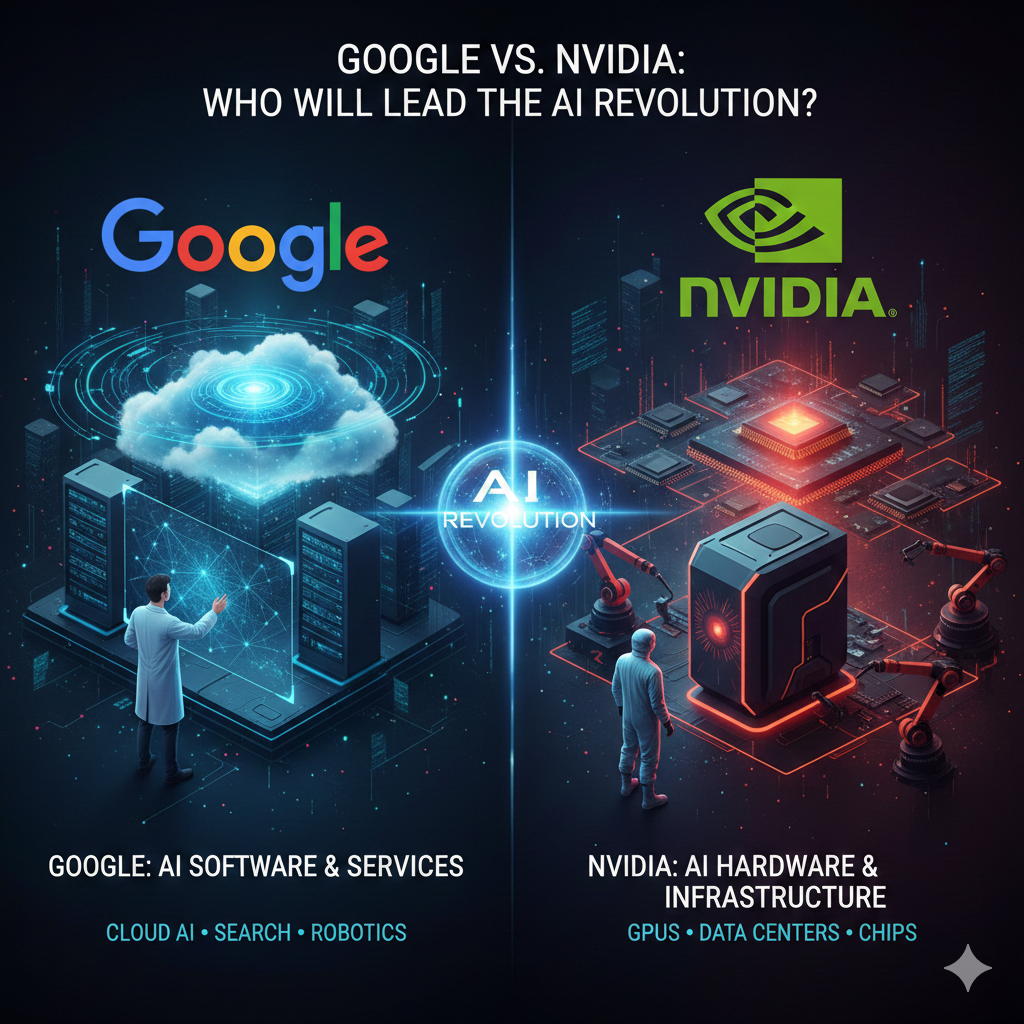
In the rapidly evolving realm of artificial intelligence, two giants, Google and Nvidia, stand at the forefront, each pushing the boundaries of innovation in their unique ways. As AI continues to reshape industries and redefine technological capabilities, the question arises: Who will lead the AI revolution? This blog post delves into the strategic dynamics between these two titans, analyzing their strengths and exploring their potential futures in the AI landscape.
AI Hardware vs. Software Dominance
The divergence in strategic focus between Google and Nvidia is profound. Google has positioned itself as a leader in AI software and cloud services, leveraging its vast infrastructure to deliver scalable AI solutions. In contrast, Nvidia has carved a niche as the dominant force in AI hardware, particularly with its industry-leading Graphics Processing Units (GPUs).
Nvidia’s GPUs have become the backbone of AI hardware, providing the computational power needed for complex machine learning tasks. However, Google’s Tensor Processing Units (TPUs) present a formidable challenge, optimized for specific AI workloads and increasingly integrated within Google’s cloud platform. The interplay between hardware and software is critical, suggesting that the future of AI leadership may hinge on a company’s ability to innovate across both domains, offering integrated solutions that maximize performance and efficiency.
Strategic Alliances and Ecosystem Development
Both Google and Nvidia understand the power of collaboration and ecosystem development in advancing their AI agendas. Strategic alliances with academic institutions, tech companies, and government agencies allow these companies to tap into new technologies and expand their influence.
Google’s partnerships often enhance its cloud and software capabilities, bringing new applications and services to its platform. Nvidia, on the other hand, focuses on hardware partnerships, ensuring its GPUs remain the standard for AI computing. These alliances not only bolster each company’s capabilities but also expand their market reach, underscoring the importance of a robust ecosystem in maintaining a competitive edge.
R&D Investments and Innovation
Innovation is the lifeblood of the tech industry, and both Google and Nvidia are heavily investing in research and development to sustain their competitive advantages. Google’s R&D efforts are centered around AI software and cloud infrastructure, driving advancements in machine learning algorithms and scalable cloud solutions. Meanwhile, Nvidia’s focus is on AI hardware and deep learning technologies, continuously pushing the envelope in GPU performance and capabilities.
The diverse paths to innovation taken by each company highlight the multifaceted nature of AI development. Sustained R&D investments are crucial for achieving technological breakthroughs, and as AI technology rapidly evolves, both companies must continue to innovate to maintain their leadership positions.
Market Dynamics and Competitive Positioning
The AI market is characterized by dynamic shifts and intense competition. Nvidia currently holds a strong position in AI hardware, with its GPUs being the preferred choice for many AI applications. However, Google’s strategic investments in AI research and cloud services are positioning it as a formidable competitor.
Google’s robust cloud platform, combined with its advancements in AI software, offers a compelling alternative to traditional hardware-centric approaches. As market conditions evolve, the ability to adapt and leverage emerging technologies will be key to sustaining leadership in the AI sector.
Future of AI Hardware and Cloud Services
The competition between Google’s TPUs and Nvidia’s GPUs highlights the ongoing evolution of AI hardware. While Nvidia’s GPUs are the industry standard for many AI tasks, Google’s TPUs offer significant advantages for specific machine learning applications, particularly within its cloud ecosystem.
Moreover, Google’s strength in AI cloud services suggests a shift toward more integrated, scalable, and cost-effective AI solutions. This trend challenges the traditional hardware-centric approach and points to a future where cloud-based AI services become increasingly dominant, providing companies with flexible and powerful tools to drive innovation.
Conclusion
The race between Google and Nvidia to lead the AI revolution is a testament to the transformative power of technology. Both companies bring unique strengths to the table, with Google excelling in AI software and cloud services, while Nvidia dominates AI hardware. The ultimate leader in AI will likely be the company that can best integrate these domains, leveraging strategic alliances, investing in innovation, and adapting to market dynamics.
As AI continues to evolve, the competition between Google and Nvidia will shape the future of technology, driving new advancements and redefining what is possible. The race is far from over, and the coming years will be crucial in determining who will lead the AI revolution.

Abhijit Daund (AD)
AD is a Senior Engineering Manager and the founder of ads2cents.com. With 13+ years of experience at companies like Walmart, he specializes in distributed systems, AI infrastructure, and software systems.